Duck Drop: Why it matters to leprosy that we change our approach to peace
Welcome to the Duck Drop series
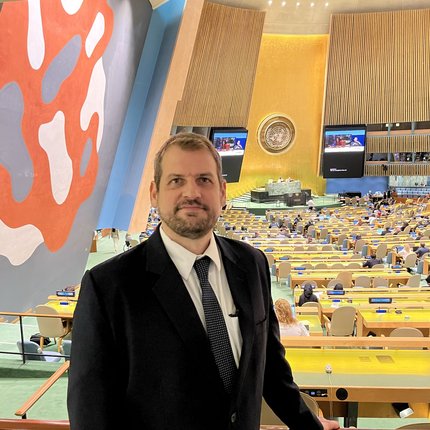
Welcome to a new series that is going to run throughout 2026: the Duck Drop. Each month, TLM International’s communications will focus on a new theme and as a part of that focus, I will be sharing a ‘Duck Drop,’ an opinion piece on the topic at hand.
Mathias Duck is The Leprosy Mission International's Global Advocacy Lead.
Throughout the month of February, we have been looking at how conflict, violence, and war hinder our efforts to end the transmission of leprosy and transform the lives of those who experience the disease. And so for my first Duck Drop, I want to build upon the excellent work done by our partners EU-CORD in their recent Peace Conversation Initiative. Consider this the next piece of the conversation.
The impact of conflict
This February, our communications channels have been covering stories of how conflict has had a direct impact on persons affected by leprosy and our work at The Leprosy Mission. It affects livelihoods and incomes so that people affected by leprosy are pushed further into poverty. We have seen how conflict prevents us from providing treatment so that impairments become severe and irreversible.
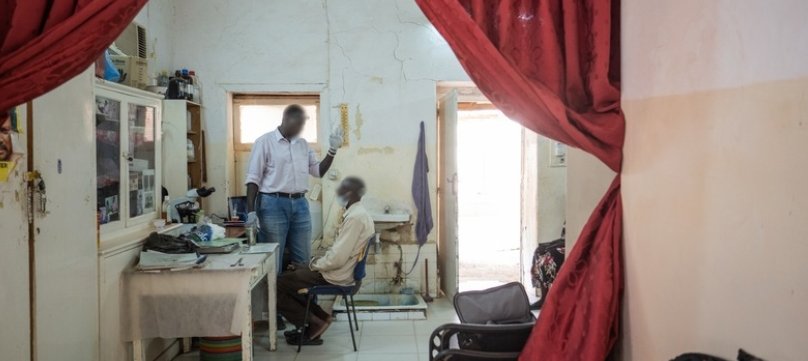
One story that stood out for me was from Sudan, where the scale of the violence caused by the civil war forced TLM to cease operations. Our clinic in Khartoum State had been providing good treatment until the conflict broke out. In the following years, there was no treatment available to leprosy patients, many of whom suffered from terrible reactions and impairments. In that context, there are people affected by leprosy who experienced severe leprosy reactions. There was no treatment available to them and the result was that they died. These were entirely preventable deaths.
I tell you this because war stories can be dramatic or heroic, but more often than not, they are stories of deep personal sadness. This is true for countless numbers of persons affected by leprosy.
Collaboration is so important to us in these contexts
We are not an organisation with a specific expertise in conflict, humanitarian aid, or peace building within the context of war. Our expertise is leprosy and whilst we do build peace, it is the peace that we nurture around and alongside persons affected by leprosy, within their communities and families, a peace that allows them to live full lives. We do this in the spirit of reconciliation that we believe God modelled for all people:
All this is from God, who reconciled us to himself through Christ and gave us the ministry of reconciliation: that God was reconciling the world to himself in Christ, not counting people’s sins against them. And he has committed to us the message of reconciliation. 2 Corinthians 5:18-19 (NIV)
One of TLM’s core values is collaboration and this is because we recognise that the scale and complexity of the problems facing us demand that we collaborate with people and organisations across the world.
We may build peace within communities, but we cannot escape the fact that we work in countries that are directly affected by armed conflict, including all of the countries we serve in Africa. That is where collaboration is so important. We can learn from, partner with, and support organisations that are experts in this work so that persons affected by leprosy can access the treatment and income that they need.
We are members of EU-CORD, a network of Christian development and humanitarian NGOs with a stake in EU politics, some of whom have a real expertise in conflict and peacebuilding. It is this expertise that prompted EU-CORD to launch the Peace Conversation Initiative. We recognise that collaboration quite often means listening and learning, so the next section has been taken directly from EU-CORD’s excellent blog, which launched the Initiative.
A better approach to conflict prevention – from EU-CORD
In 2025, defence expenditure amongst EU member states increased by 11% compared to the previous year and accounted for 2.1% of EU member states’ GDP. The contrast is stark: billions for military readiness, fractions for the patient work of building peaceful societies. This imbalance reflects a deeper problem in how we conceptualise peace itself.
For decades, peace had been framed as something “done” in post-conflict settings—a technical intervention with clear beginnings and endpoints. Donor funding flows toward ceasefire monitoring and disarmament programs. Success gets measured in signed agreements and violence statistics. Meanwhile, the slow erosion of social cohesion in stable democracies, the exclusion that festers into extremism, the institutional weaknesses that make communities vulnerable—these rarely register as peace concerns until a crisis erupts. This incomplete framing has consequences. It separates “conflict prevention” from “development,” as if strong institutions, economic opportunity, and social inclusion weren’t themselves peace infrastructure.
What do I take away from this message?
- Firstly, that it is worth reading the rest of the piece – it’s excellent.
- Secondly, that persons affected by leprosy are best served when we invest not only in ending conflicts but commit to maintaining peace, no matter how fragile or certain that peace appears. That is what TLM does when we work with persons affected by leprosy to build peace in their worlds.
- Lastly, I take away how grateful I am to be partners with organisations that show this kind of commitment to ensuring and creating peaceful societies. Persons affected by leprosy are in a stronger position thanks to their work.
Read more about this with EU-CORD’s publication “The Missing Piece in Peace”.