Duck Drop: Will the rise of AI come at a cost to people affected by leprosy?

Welcome to the latest Duck Drop blog, a series that we are running in 2026. Each month, TLM International’s communications will focus on a new theme and as a part of that focus, I will be sharing a ‘Duck Drop,’ an opinion piece on the topic at hand. This month we are reflecting on the implications of AI for people affected by leprosy, considering both how it shapes representation and the ways it could support diagnosis.
Will the rise of AI come at a cost to people affected by leprosy?
This month, TLM has been looking at the ways in which AI can support our goal of defeating leprosy and transforming lives. It has been exciting to see how new, modern tools can help us to end this ancient disease. I hope these technologies can make a huge difference.
However, it’s important to acknowledge that rarely do enormous evolutions in our world come without a cost. We have seen this throughout human history and most recently in the advent of social media, which has helped us become more connected whilst also harming our mental health and communities. AI will be a leap forward for many people and in many sectors, but there will be collateral damage, especially if we continue at this pace of development and without more safeguards in place.
So, my question is: to what extent do persons affected by leprosy risk becoming a part of that collateral damage?
A tool that reflects its makers and dominant cultures
AI tools have largely been created by male engineers in the West, and they learn from the wealth of open-source information that is available online: a wealth of information that is heavily dominated by Western and Eurocentric perspectives.
This matters because many people now use AI tools as search engines and tools to help them understand the world. We do not want AI to become our primary source of information if it bases its knowledge on only a select few global cultures. We want knowledge and traditions from across the world to be a part of our future. But why does that matter for persons affected by leprosy?
Firstly, leprosy is a disease primarily found outside of the West, so it is the cultures of persons affected by leprosy that are at risk of being underrepresented or misrepresented.
But more specifically for persons affected by leprosy and persons with other disabilities, AI leans towards what is most common and what might be considered typical. That is usually not persons with disabilities and if you ask specifically for persons with disabilities to be represented, you don’t get much diversity represented within that. Below are two images ChatGPT gave us when we asked for an image of a person with disabilities in cartoon style, both leaning into stereotypes and not reflective of the diversity within disability.
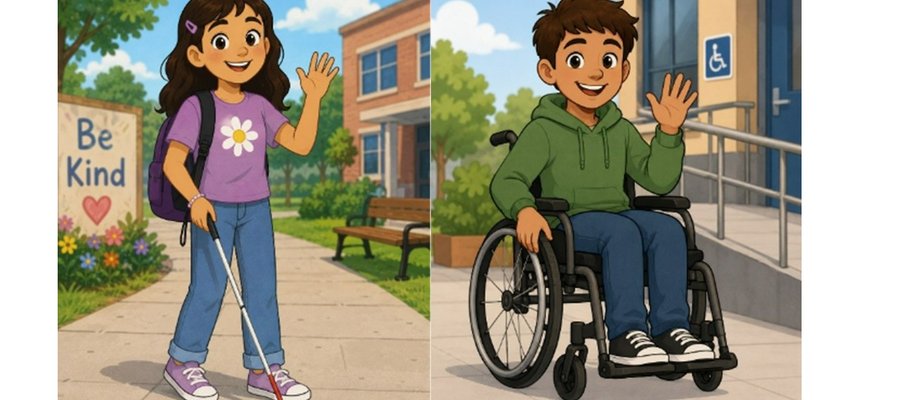
This might seem like a small thing, but AI could prove to totally dominate the materials that we see online and, consequently, the way that we see the world. So, if it creates one-dimensional images that lack diversity, communities that are already marginalised and underrepresented become even more so. Persons affected by leprosy certainly fall within that category.
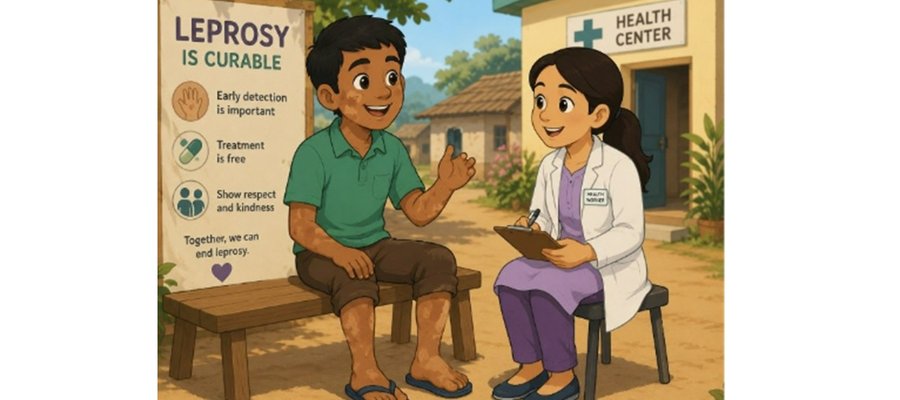
To understand more, we continued the conversation with ChatGPT and asked it to create cartoon images of leprosy. Below is what it gave us:
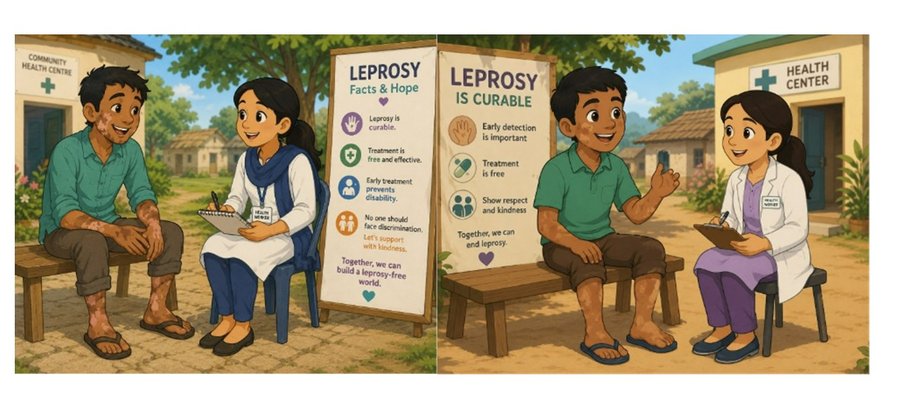
There are things to be commended here. The health messages are good, and it has given us a context where leprosy is more likely to be seen; we’re in a rural place rather than downtown Manhattan or an Italian beach. You also cannot detect any stigma in the photos, which is what we want people to see in leprosy and I’m grateful for that.
Beyond that, there are issues. My biggest issue: why does the healthcare worker have lighter skin than the patient in both images? This pattern may reflect bias or reinforce harmful stereotypes. That seems to be the impression AI has taken from its sources. Another issue is that leprosy skin patches do not look like this, but other skin conditions may do.
How, how often, and when minority groups are represented in media is important and has a big impact on how we perceive minoritised people.
But these biases are not only cosmetic. The UN Special Rapporteur on Disability has written a report on AI and disability, which highlights that biases in AI can affect whether a person with disabilities can access social protection, healthcare, jobs, or education. They are often built without consulting persons with disabilities and are therefore inaccessible and not inclusive.
Right now, AI companies are steaming ahead with their development at lightning speed, prioritising progress and profit over ensuring that all communities are heard and represented. It would seem the tech industry adage ‘move fast and break things’ is at play here.
The environmental impact of the physical infrastructure behind AI is becoming clearer and clearer. For AI leaders, growth is more important than care for our planet, something that will come at the cost of persons affected by leprosy. The vast data centres powering AI require enormous amounts of electricity and water for cooling, placing additional strain on already scarce resources in climate vulnerable communities, where people affected by leprosy often live. Studies estimate that AI related activity in 2025 was responsible for around 80 million tonnes of carbon dioxide emissions, a figure comparable to the annual emissions of a large city. The communities that are least responsible for these emissions, including many affected by leprosy, are the ones who suffer most due to climate change-intensified droughts, floods and extreme heat.
More attention is also being brought to how AI affects women, particularly vulnerable and marginalised women such as those affected by leprosy. According to International Telecommunication Union, in low-income countries, latest estimates show that 32% of men use the internet, compared with only 20% of women. This digital gender divide creates a data gap that leaves AI tools with a strong gender bias.
If its training data reflects societal stereotypes, the AI is likely to reproduce those same biases in its responses. For vulnerable women in low-income countries, and for women with disabilities, AI bias strongly reinforces the belief that women, particularly minoritised women, do not belong in high-earning fields, in which they are already severely underrepresented. This issue has been extensively explored by organisations like UN Women.
For the same reason, AI can also come at a disadvantage to women’s health. As AI tools are mostly developed by men, when women use AI-powered systems to diagnose illnesses, they often receive inaccurate answers, as AI lacks an understanding of women’s bodies, and of how symptoms may present differently in women. As the symptoms of leprosy are typically the same in men and women, we could easily claim that this gender bias won’t affect people with leprosy. However, leprosy can result in a wide range of complications which of course present differently in people with different bodies.
Ultimately, AI tools have the potential to revolutionise global healthcare, improving disease prevention and speeding up diagnosis for people affected by all diseases, including leprosy. We have tools like the WHO Skin NTDs App, that can be of great help for health workers, and AI could certainly speed up certain processes. However, safeguards must urgently be put in place to improve AI tools if they are going to benefit people with leprosy as opposed to further disadvantaging them.