Duck Drop: How are we to ensure that women find their voice within advocacy?
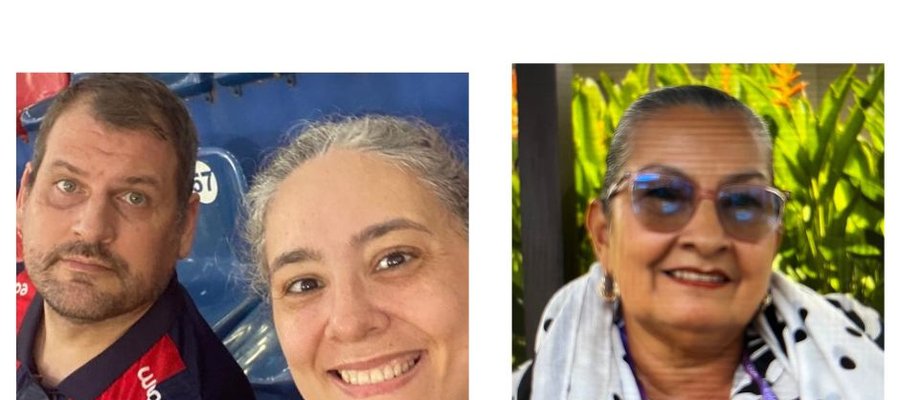
In March we commemorated International Women’s Day, and honour the fight that many have given to create a more equal world. I deeply admire the women involved in the fight against leprosy, and I wanted this Duck Drop to provide a space for them to share their perspective with all of us. With this in mind, I have invited two remarkable advocates my dear friend, Lucrecia – a member of TLM’s Advocacy Working Group, as well as my wife, Cynthia, to discuss this topic with us.
I also wanted to give you the chance to read their answers in Spanish, so we can open up the conversation and share it with a broader audience, including Latin America, where Lucrecia, my wife, and I are originally from. I hope you find this discussion as inspiring and challenging as I did.
Again, I answer these questions from my perspective as a man: as an observer and a listener, but someone without first hand knowledge. Consequently, I have chosen to engage these topics together with my wife, Cynthia.
1.What specific challenges do women face in the advocacy field?
Cynthia and Mathias:
First of all, most women are the primary caretakers of their home and family. This takes up a good portion of their time and energy, therefore limiting their participation in activities like advocacy. This is somewhat similar to other areas.
In fact, after a woman has taken care of her family and her home, there might still be people questioning her participation in advocacy. Because of cultural assumptions and prejudice, comments like “Don’t you have a family and a home to take care of?” can be an added barrier.
In a world that has been traditionally dominated by men, there are a number of visible and invisible barriers for women. Most people, regardless of their gender, don’t jump from a quiet life at home to participating actively in advocacy. There is often a journey that leads to more and more empowerment through participation in different activities, being heard and valued in different contexts, and recognising the importance and the possible impact of speaking up and contributing.
Lucrecia:
Women nowadays face major challenges due to gender inequality, which is the source of the majority of the problems affecting women and girls at every stage of life and can be particularly detrimental to them, in different aspects. These include violence within their households, sexual violence and human rights violations, but also involves barriers to access education, medical assistance or work opportunities. It also prevents them from actively participating in decision making and different social programmes.
2.What actions are needed to ensure women can fully participate in advocacy?
Cynthia and Mathias:
First of all, we need to see and think about women and girls as full participants in everything. We need to challenge cultural assumptions that limit women and girls’ participation in advocacy.
Then, we need to create spaces for the journey of empowerment to be accessible for women and girls. Perhaps this can start by making sure women and girls are present and heard at any activity that is taking place within their community.
Perhaps not every woman will want to be an advocate, but those who want to, should have opportunities to grow in it.
Lucrecia:
In both public and private life, women face professional segregation, stereotypes, and traditional customs. In some countries, discriminatory and outdated laws add to the many barriers women continue to confront in the 21st century—for example, regarding property rights, access to credit, education, decent work opportunities, healthcare, communication, recreation, and participation in politics and decision-making.
The only way to overcome these barriers is through awareness, education, and the strength of will that emerges from enduring serious violations of rights. At some point in life, with a little support, initiative, and determination, it is possible to build a better future and serve as a living testimony for other women.
3. Do you know of any woman, aside from Lucrecia, who has managed to overcome those barriers? If so, how did she do it?
Cynthia and Mathias:
Yes. We know of many women in different countries, but we also must admit that we did not ask them this question directly, so we will stick to what we have observed so far, and perhaps we might be making some assumptions.
Also, the fact that some barriers have been overcome in one context does not imply that all barriers have been overcome in every aspect – especially as women.
These women are incredibly strong, resilient, creative, caring, patient, long-suffering, and forgiving. Secondly, they seem to focus on where they can get their support from, either from family, friends, friends of friends, faith, and they are always looking for allies.
We would say that they are on this journey, where every activity, every speaking opportunity, every conversation, every meeting leads to more empowerment.
Lucrecia:
There are many women who have overcome barriers that, for a time, seemed to derail their lives. Some of them have not been affected by leprosy, yet they have taught us the value of being a woman and a creator of life. Beyond that, a woman who identifies today as a holistic leader within a community with social prejudices—often a result of lack of education—must be very careful, because in many cases we are considered a threat when we raise our voices in support of the most vulnerable. Around the world, there are women affected by leprosy whose voices and resilience are truly admirable.
At TLM, we will be continuing this discussion in April, when we will host a seminar at our meeting in London of all TLM countries on the subject of how women can have their voices heard through advocacy. We will hear from Lucrecia, as well as other practitioners and the UN Special Rapporteur on leprosy. We hope these discussions can prompt wider thoughts around ensuring women affected by leprosy have their invaluable perspectives heard.